

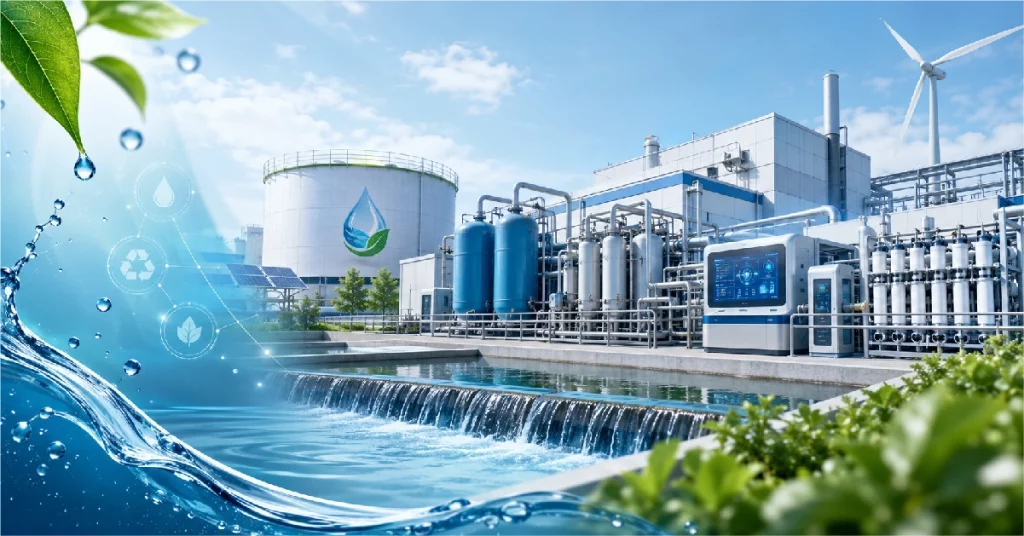
Modern industrial plants manage much more than incoming water. They must also control process water, cooling and boiler circuits, wastewater, water reuse, and other environmental requirements.
Managing each system separately can create multiple operational interfaces and make it harder to maintain consistent performance.
Water and environment management services provide a more integrated approach by bringing water treatment, wastewater treatment, recycling, utility-water management, and environmental solutions together.
For industrial plants in Portugal, this approach can support more efficient resource use, reliable water quality, and better long-term management of treatment infrastructure.
What Is Total Water and Environment Management?
Total water and environment management means managing the complete water and environmental cycle of an industrial facility rather than treating individual systems as separate requirements.
This can include:
- Raw and process water treatment
- Wastewater treatment
- Water recycling and reuse
- Cooling water management
- Boiler water treatment
- Desalination
- Effluent management
- Solid waste management
- Energy recovery
- Operation and maintenance
Ion Exchange’s documented capability extends from total water management to integrated environmental management covering water, liquid and gaseous effluents, solid waste, and recovery of energy from waste.
Why Do Modern Industrial Plants Need Integrated Water Management?
Industrial facilities often operate several water systems simultaneously.
A single plant may need:
- Treated process water
- Demineralised water
- Cooling water
- Boiler feed water
- Wastewater treatment
- Recycled water
When these systems are managed independently, opportunities to optimise water consumption, recycling, chemicals, and operating costs can be missed.
An integrated approach considers the complete cycle:
Water intake → Treatment → Industrial use → Wastewater generation → Treatment → Recovery → Reuse
This can help industries manage water quality and resource use more systematically.
What Do Water and Environment Management Services Include?
-
Water Treatment
Source water can be treated through clarification, filtration, softening, demineralisation, membranes, or other suitable technologies according to the required water quality.
-
Wastewater Treatment
Industrial effluent can be treated using physical, chemical, biological, and membrane-based processes before discharge or reuse.
-
Water Recycling
Treated wastewater can be recovered for suitable applications such as cooling, utilities, cleaning, or process use.
Ion Exchange’s historical water-recycling material identifies recycled water as an additional, dependable source of supply and describes integrated physico-chemical, biological, and membrane processes for water recovery.
-
Cooling and Boiler Water Management
Cooling and boiler circuits require controlled water chemistry to manage scaling, corrosion, and other operational challenges.
-
Environmental Management
A broader environmental approach can also include management of liquid and gaseous effluents, solid waste, and energy recovery.
How Integrated Water Management Improves Industrial Efficiency?
-
Better Water Utilisation
Treating and recycling water can help reduce unnecessary freshwater consumption and improve resource efficiency.
-
Consistent Water Quality
Managing interconnected water systems through one coordinated approach can support consistent treated-water quality across process and utility applications.
-
Reduced Operational Complexity
A single specialist managing multiple water systems can reduce the number of separate interfaces that plant operators need to coordinate.
-
Better Cost Control
Optimising treatment, chemicals, maintenance, recycling, and water consumption can contribute to lower operating costs.
Ion Exchange’s documented total-water-management experience highlights single-point responsibility, consistent supply and quality, improved production efficiency, lower costs, and more effective use of capital as benefits of an integrated service approach.
Water Recycling and Reuse for Industrial Plants
Water recycling is an important component of sustainable water management for industrial plants.
The basic approach is:
Wastewater → Treatment → Advanced purification → Recovered water → Reuse
Depending on the required quality, treatment may combine:
- Biological treatment
- Microfiltration
- Ultrafiltration
- Nanofiltration
- Reverse osmosis
- Membrane bioreactors
The appropriate combination depends on the wastewater characteristics and intended reuse application.
Ion Exchange’s documented recycling solutions include treatment and recovery of wastewater for reuse in cooling-water makeup, toilet flushing, vehicle washing, gardening, and other suitable applications.
Managing Industrial Wastewater and Environmental Streams
Total environment management extends beyond conventional wastewater treatment.
Industrial facilities can generate different environmental streams that require coordinated management.
-
Liquid Effluents
Effluent treatment and recycling systems can manage wastewater generated from manufacturing processes, utilities, and other plant operations.
-
Gaseous Effluents
Where applicable, environmental management can also include treatment and control of gaseous emissions.
-
Solid Waste
Sludge and other solid waste generated during industrial operations and treatment require appropriate handling and management.
-
Resource and Energy Recovery
Some treatment processes can provide opportunities for recovery of useful resources or energy from waste streams.
Ion Exchange’s integrated environment-management capability has historically covered liquid and gaseous effluents, solid waste, and recovery of energy from waste.
Why Single-Point Responsibility Matters?
Managing a plant’s water systems through multiple suppliers can create challenges when different systems interact.
For example, changes in raw-water quality can affect pretreatment, process water, boiler operation, cooling systems, and wastewater generation.
A specialist providing integrated industrial water management services can evaluate these systems together.
This can provide:
- Coordinated operation
- Consistent water quality
- Easier performance monitoring
- Better maintenance planning
- Faster technical response
- Greater accountability
Ion Exchange’s documented TISCO project demonstrates this model, where comprehensive water management included water and wastewater treatment, cooling-tower management, cooling-water chemical treatment, and O&M under a single service approach.
Turnkey Water and Environment Management Services
For larger industrial projects, integrated management can begin at the project-design stage.
Services can include:
- Process design
- Engineering
- Equipment selection
- Plant construction
- Installation
- Commissioning
- Automation
- Operation and maintenance
Ion Exchange’s infrastructure capabilities have included turnkey EPC and BOO/T projects covering water supply, sewage treatment, wastewater recycling, seawater intake and desalination, pumping stations, solid waste management, waste-to-energy projects, industrial utility complexes, and O&M services.
This allows industrial plants to consider water and environmental requirements as part of the overall project rather than as isolated systems.
Ion Exchange Water and Environment Management Services
Ion Exchange provides integrated water and wastewater treatment services across industrial applications, combining treatment technologies with engineering and lifecycle support.
Its capabilities include:
- Water treatment
- Wastewater treatment
- Water recycling and reuse
- Cooling and boiler water treatment
- Membrane systems
- Ion exchange
- Desalination
- Environmental management
- Operation and maintenance
- Turnkey EPC and BOO/T projects
The company’s documented total water management approach is designed to address the complete process cycle, helping customers manage water quality, treatment, recycling, utilities, and environmental requirements through integrated solutions.
For modern industrial plants, this integrated model can reduce the complexity of managing multiple treatment systems while supporting reliable and efficient plant operation.
Choosing the Right Industrial Water Management Partner
When evaluating integrated water management solutions, industries should look beyond individual treatment technologies.
Consider whether the partner has:
- Technology breadth: Can it address water treatment, wastewater, recycling, membranes, resins, and utility-water management?
- Engineering capability: Can it design and integrate the complete treatment system?
- Lifecycle support: Can it provide O&M, maintenance, monitoring, and technical support?
- Environmental expertise: Can it address wastewater and broader environmental-management requirements?
- Project capability: Can it execute turnkey projects where required?
- Single-point responsibility: Can one specialist coordinate multiple water and environmental systems?
These factors can be particularly important for large industrial plants where water systems are closely interconnected.
Conclusion
Modern industrial plants need to manage water, wastewater, recycling, utilities, and environmental requirements as connected systems.
Total water and environment management services provide an integrated approach that can improve water utilisation, support consistent quality, simplify operations, and create opportunities for recycling and resource recovery.
Ion Exchange combines water and wastewater treatment technologies with engineering, environmental management, turnkey project execution, and lifecycle services.
Connect with Ion Exchange experts for integrated water management, wastewater treatment, recycling, and environmental management solutions for industrial plants in Portugal.
FAQs
-
What are water and environment management services?
They involve managing an industrial facility’s water treatment, wastewater, recycling, utility water, and broader environmental requirements through an integrated approach.
-
Why is total water management important for industrial plants?
It helps industries manage interconnected water systems together, improving water utilisation, treatment consistency, operational coordination, and opportunities for recycling and reuse.
-
Can treated industrial wastewater be recycled?
Yes. Depending on the wastewater characteristics and required reuse quality, treated wastewater can undergo additional purification and be reused for suitable industrial and utility applications.
-
What does Ion Exchange include in total water management?
Ion Exchange’s capabilities include water treatment, wastewater treatment, recycling and reuse, cooling and boiler water treatment, membranes, ion exchange, desalination, environmental management, and lifecycle services.
-
Does Ion Exchange provide operation and maintenance services?
Yes. Ion Exchange’s documented service capabilities include operation and maintenance of complete water and wastewater treatment systems, along with cooling-water and utility-water management.