

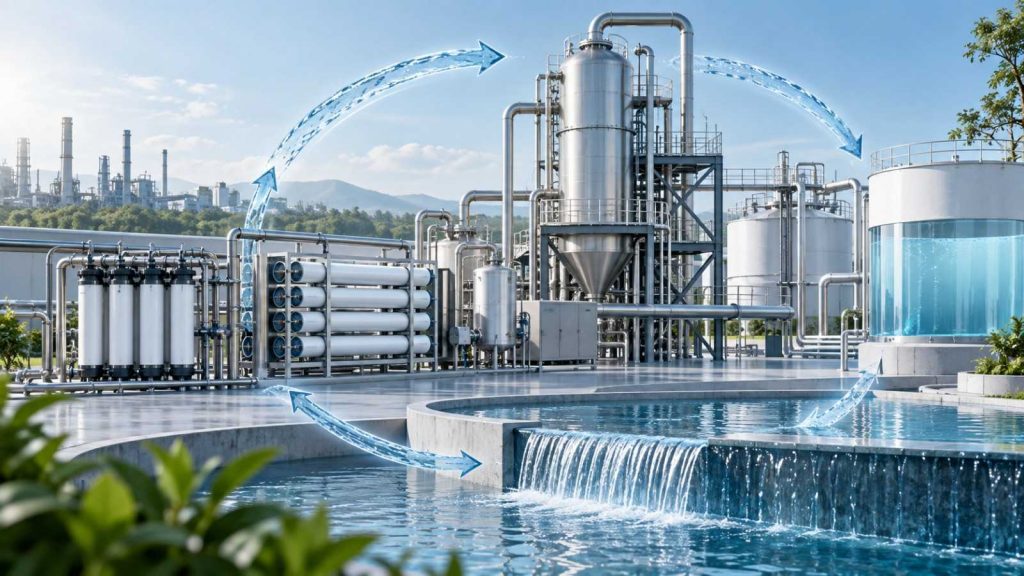
Water is no longer simply a utility for industrial plants; it is becoming an operational risk, a cost centre and, increasingly, a resource that must be recovered. For water-intensive industries, continuously drawing fresh water while sending treated effluent out of the facility is becoming harder to justify.
Zero Liquid Discharge changes that equation by treating wastewater as a recoverable resource, helping industries reduce freshwater dependence, improve water security and move towards a more circular approach to production. Ion Exchange positions its ZLD solutions around advanced effluent treatment, membrane technologies and evaporation processes designed to maximise water recovery.
Why Zero Liquid Discharge Matters for Industrial Water Recycling
A typical wastewater treatment facility is built to treat water so that it can be discharged. On the other hand, a zero-liquid discharge (ZLD) system tries to answer the opposite question: how much of the wastewater can be returned to the treatment facility.
A conventional ZLD system generally includes different procedures of treatment depending on the level of wastewater contamination. For example, pre-treatment of wastewater removes materials that can cause problems in the later stages of treatment. Further purification of the water includes methods of membrane filtration, such as ultrafiltration, nanofiltration and reverse osmosis, which allow collecting usable water, but rejecting concentrated waste water residue.
The goal of ZLD systems is to recover as much usable water as possible and, at the same time, not to allow liquid waste to leave the facility. According to Ion Exchange, ZLD has all necessary technologies to treat wastewater and recover water while being compliant with pollution control requirements.
ZLD systems are especially suitable for industries that consume large amounts of water and discharge water with specific requirements or that have problems with disposal of sewage.
Key Benefits of Zero Liquid Discharge for Industries
1. Reduces Dependence on Freshwater Sources
One of the strongest business cases for Zero Liquid Discharge is water security.
Manufacturing plants need reliable water for process operations, cooling, utilities, cleaning and other applications. When a facility depends almost entirely on external freshwater supplies, scarcity, changing availability or increasing water costs can affect operations.
Through industrial water recycling, treated wastewater can be returned to suitable plant applications rather than being discarded. Ion Exchange lists reduced freshwater requirements and improved availability of water for process and lower-grade uses among the benefits of its ZLD approach.
For a plant operating year after year, that reduction in freshwater demand can become strategically significant.
2. Turns Wastewater Into a Reusable Resource
The value of ZLD is not merely that it treats wastewater more thoroughly. It changes the role wastewater plays within the facility.
With well-designed wastewater recycling, recovered water can potentially be reused for cooling towers, utilities, washing or selected process requirements, depending on the required water quality. This creates a loop in which water stays productive for longer instead of moving through the plant only once.
Modern water reuse systems therefore need to be designed around the intended reuse application. Water being returned to a sensitive manufacturing process may require different treatment from water intended for cooling or general utility use.
That distinction matters. Effective recycling begins with understanding the quality required at the point of reuse, not simply installing more treatment equipment.
A Real Example of Water Recovery in the Textile Industry
Ion Exchange’s 2009 publication provides an interesting example from the Angeripalayam Common Effluent Treatment Plant in Tirupur. The project served approximately 80 bleaching and dyeing units generating around 10 MLD of wastewater containing high dissolved solids, organics and colour. Ion Exchange developed the treatment scheme after piloting combinations of biological, chemical, resin and membrane-based technologies.
According to the case study, the system used a flat-sheet membrane bioreactor and two-stage reverse osmosis for effluent recycling, followed by treatment of the RO reject through silica removal, sand filtration and nanofiltration. More than 82% of the feed was recovered as RO permeate, while another 11% was obtained as a brine stream suitable for reuse in dyeing—meaning approximately 93% of the effluent was being directed towards beneficial reuse at that stage of the process. These figures relate specifically to this historical installation and should not be treated as universal recovery guarantees for every ZLD plant.
The lesson is still highly relevant: strong industrial water recycling performance comes from designing the treatment train around the wastewater chemistry and the plant’s actual reuse opportunities.
How ZLD Strengthens Industrial Wastewater Treatment
A ZLD strategy can also push organisations to think about industrial wastewater treatment more systematically.
Instead of treating all wastewater as one combined stream, engineers can examine where individual streams originate, what contaminants they contain and whether some water can be recovered before it becomes heavily contaminated.
That can lead to practical improvements such as segregating high- and low-TDS streams, reducing unnecessary hydraulic loads, improving pretreatment, optimising membrane recovery and identifying useful by-products.
In other words, Zero Liquid Discharge works best when it becomes part of plant-wide water management rather than an isolated end-of-pipe installation.
What Should Industries Consider Before Implementing a ZLD System?
Installing a zero liquid discharge system should start with detailed water and wastewater mapping.
First of all, it is essential for plants to recognize their daily and seasonal flow changes, total dissolved solids, organics, degrees of acidity and silica among others. After that, it is necessary to recognize proper points of reuse and develop water quality requirements for every application.
Another important thing to concentrate is on energy consumption. The procedure of concentrating waste is getting more complex due to higher consumption of energy, therefore, optimization of membranes, pretreatments and effective evaporation can be a significant factor affecting the costs.
Finally, operators should take into account such issues as maintenance, fouling of membranes, consumption of chemicals, appropriate instruments and availability of working skills while designing the system.
Ion Exchange: An Integrated Partner for Water Recovery
Ion Exchange brings together engineering, resins, membranes, specialty chemicals, instrumentation and service support across water and wastewater management. Its Portugal operations also serve industrial customers with water and wastewater treatment systems, Hydramem RO/NF/UF membranes, INDION resins, chemicals and integrated engineering solutions.
For industries evaluating wastewater recycling or advanced industrial wastewater treatment, this integrated capability can simplify one of the hardest parts of ZLD implementation: coordinating multiple treatment technologies around one performance objective.
Ion Exchange’s broader engineering portfolio covers water treatment, wastewater treatment, water reuse and ZLD solutions, with services extending into operations and maintenance, rehabilitation, audits, consulting and remote monitoring.
Building a More Water-Secure Industrial Operation
Zero Liquid Discharge is ultimately about getting more value from every unit of water entering an industrial facility. Done well, it can reduce freshwater requirements, increase recovery, minimise liquid discharge and strengthen long-term water resilience.
But the strongest projects are rarely created by choosing a technology first. They begin by studying the wastewater, identifying realistic reuse opportunities and then engineering the treatment train around those conditions.
For industries considering a more circular approach to water management, Ion Exchange can assess existing water flows and develop an integrated treatment and recovery strategy suited to the plant.
Talk to Ion Exchange’s water and wastewater specialists to evaluate the right recovery approach for your facility.
Frequently Asked Questions
What is a ZLD system in industrial wastewater treatment?
There is a specific design of the treatment process, which is responsible for recovering water for reuse from the industrial wastewater and stopping it from being expelled from the facility. The treatment process may consist of biological, membrane, chemical and thermal processes, which will depend on the composition of the waste stream.
How does ZLD support industrial water recycling?
It treats and separates wastewater so that recovered water can be returned to appropriate plant applications. This can reduce dependence on freshwater while creating a more circular water-management model.
Which industries can benefit from ZLD?
Water-intensive or high-effluent industries such as textiles, chemicals, pharmaceuticals, power, food processing, metals and petrochemicals may consider ZLD where water scarcity, reuse objectives or discharge requirements justify the investment.
Can treated wastewater be reused directly in manufacturing?
Not automatically. The required treatment depends on the quality needed at the point of use. Process water may require considerably higher purity than cooling, cleaning or utility applications.
What determines the cost of a ZLD plant?
The importance of various aspects such as wastewater flow, pollutant level, recovery goal, pretreatment needs, membrane arrangement and demand for evaporation as well as energy consumption and continuous function and maintenance rely on these fundamental aspects. Thus, the necessity of thorough wastewater evaluation is necessary initially before a solution is chosen.